- This Week in History
- Posts
- This Week in History #6
This Week in History #6
January 24, 2025 - January 30, 2025
Welcome to this week’s edition of This Week in History!
Sign up to receive this newsletter in your inbox every Friday @ 12PM EST.
January 24, 1984: Apple releases the Macintosh Computer

Steve Jobs, co-founder & CEO of Apple poses with the original Macintosh
The release of the Macintosh was a groundbreaking moment in computing, introducing a graphical user interface and a mouse, making computers far more user-friendly. Its sleek, compact design housed innovative features like a 9-inch display and 128 KB of memory.
Since the launch of the original Macintosh, Apple has expanded its product lineup significantly, introducing devices such as the iPod, iPhone, iPad, Apple Watch, and various Mac models. The iPhone, introduced in 2007, has been particularly successful, with over 2.3 billion units sold and a user base exceeding 1.5 billion active users as of 2023.
Notable Events:
1857: University of Calcutta is founded as the first full university in South Asia.
1935: The first canned beer is sold.
1989: Serial killer Ted Bundy is executed by electric chair in Florida.
This week’s edition of This Week in History is brought to you in partnership with 1440 Media.
Fact-based news without bias awaits. Make 1440 your choice today.
Overwhelmed by biased news? Cut through the clutter and get straight facts with your daily 1440 digest. From politics to sports, join millions who start their day informed.
January 25, 1971: Charles Manson and 4 “Family” members are found guilty of murdering Sharon Tate and six others

Charles Manson & defence lawyer in court (Left), Sharon Tate headshot (Right)
Charles Manson and four members of his "Family" cult were convicted of the 1969 Tate–LaBianca murders, a series of brutal killings that shocked the nation. The victims included actress Sharon Tate, who was eight months pregnant (with Roman Polanski), and six others, murdered over two nights.
Manson manipulated his followers, convincing them to commit these heinous acts as part of his imagined race war, inspired by a distorted interpretation of The Beatles' music. The trial gained global attention for its gruesome details, Manson’s erratic courtroom behavior, and the unwavering loyalty of his followers. Initially sentenced to death, Manson and his accomplices had their sentences commuted to life in prison after California abolished the death penalty in 1972.
The murders have been the subject of many adaptations and documentaries, with the most recent being Quentin Tarantino’s Once Upon a Time in Hollywood, where Sharon Tate is portrayed by Margot Robbie.
Notable Events:
1533: Henry VIII of England secretly marries his second wife Anne Boleyn.
1554: São Paulo, Brazil is founded.
1949: The first Emmy Award is presented at the Hollywood Athletic Club.
January 26, 1905: The world’s largest diamond is found
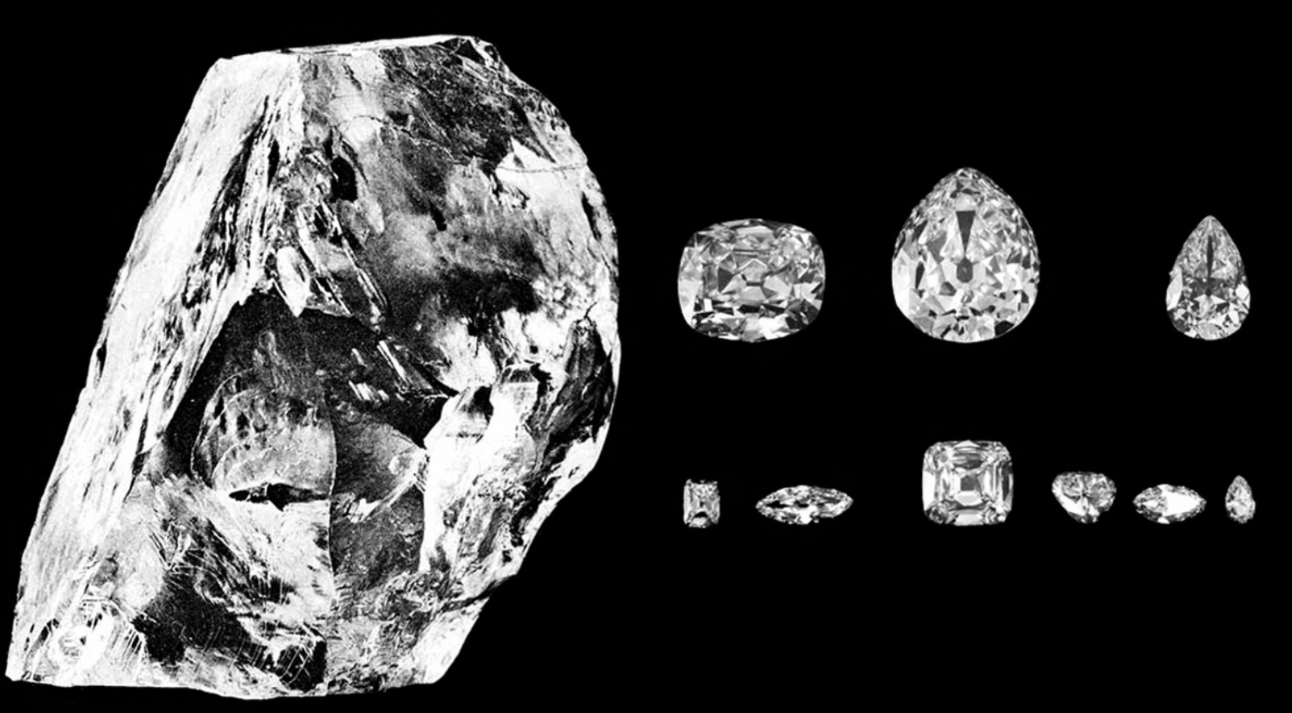
The Cullinan diamond (far left) against other large diamonds
The Cullinan Diamond, weighing an extraordinary 3,106.75 carats, is the largest gem-quality diamond ever discovered. Found at the Premier Mine in South Africa, it was later cut into several famous gems, including the Great Star of Africa and the Lesser Star of Africa, both part of the British Crown Jewels.
Notable Events:
1926: The television is demonstrated for the first time.
1998: President Bill Clinton denies having a relationship with Monica Lewinsky on a television broadcast.
January 27, 1880: Thomas Edison patents the incandescent lamp
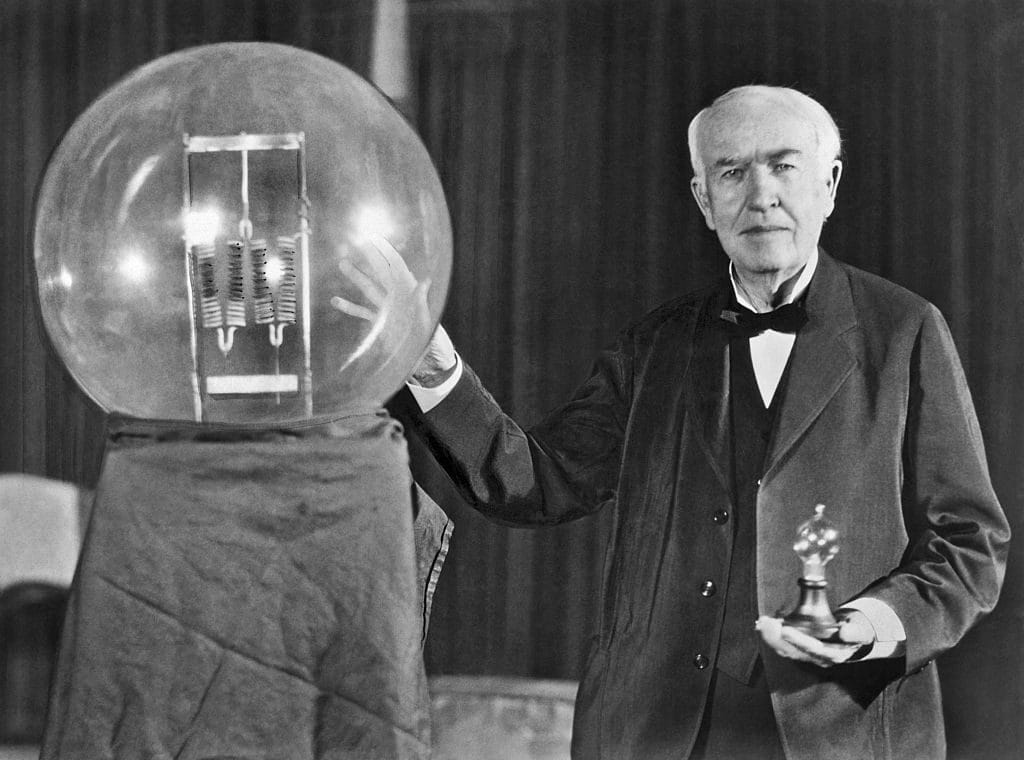
Thomas Edison poses with two versions of his invention
Thomas Edison receives a patent for his improved incandescent lamp, revolutionizing artificial lighting. His design featured a carbon filament and a practical vacuum-sealed bulb, making electric lighting more efficient and commercially viable. This invention paved the way for widespread use of electric light, transforming industries and daily life worldwide.
Notable Events:
1302: Dante Alighieri is condemned in absentia and exiled from Florence.
1343: Pope Clement VI issues the papal bull Unigenitus to justify the power of the pope and the use of indulgences. Nearly 200 years later, Martin Luther would protest this.
2010: Apple announces the iPad.
January 28, 1077: Holy Roman Emperor Henry IV’s excommunication is lifted after deal with Pope Gregory VIII is brokered by Duchess Matilda of Tuscany

Holy Roman Emperor Henry IV waits three days outside Canossa Castle
The Walk to Canossa in 1077 was a pivotal moment in the Investiture Controversy, a power struggle between Pope Gregory VII and Henry IV, Holy Roman Emperor. The Holy Roman Emperor sought to assert authority of church position appointments, which led to his excommunication.
During the power struggle Duchess Matilda di Canossa of Tuscany, a powerful Italian noblewoman and staunch supporter of Pope Gregory VII, provided refuge for him in her castle. She acted as a mediator and her influence and loyalty to the papacy were instrumental in facilitating the dramatic meeting where Henry humbled himself to seek forgiveness.

Matilda di Canossa holds court (left), and portrait (right)
For three days, Henry IV stood barefoot in the snow outside the Canossa Castle symbolizing his submission to papal authority. The pope eventually lifted the excommunication, restoring Henry IV to the church. However, the conflict between secular and papal powers continued for years, shaping the relationship between church and state in medieval Europe. This dramatic event showcased the increasing power of the papacy and the limits of imperial authority during the Middle Ages. It remains a symbol of the complex interplay between religious and political forces.
January 29, 1936: First inductees of the Baseball Hall of Fame are announced

Babe Ruth speaking at the 1936 opening ceremony.
In 1936, the Baseball Hall of Fame announced its first five inductees: Ty Cobb, Babe Ruth, Honus Wagner, Christy Mathewson, and Walter Johnson. These players were chosen for their extraordinary contributions to baseball, setting the standard for excellence in the sport. The Hall of Fame, located in Cooperstown, New York, honors the greatest figures in baseball history.
Notable Events:
1886: Karl Benz patents the first successful gasoline-driven car.
1891: Liliʻuokalani is proclaimed the last monarch and only queen of Hawaii.
2002: In his State of the Union address, President George W. Bush describes "regimes that sponsor terror" as an Axis of evil including Iraq, Iran and North Korea.
January 30, 1889: The Mayerling Incident starts the chain of events leading to WWI

Crown Prince Rudolf and Baroness Mary Vetsera
Crown Prince Rudolf of Austria, heir to the Austro-Hungarian throne, and his mistress, Baroness Mary Vetsera, are discovered dead in an apparent murder-suicide at Mayerling, a royal hunting lodge. Known as the Mayerling Incident, the crime shocked Europe and created a major scandal for the Habsburg dynasty.
The event left the aging Emperor Franz Joseph without a direct male heir, significantly altering the succession and the future of the Austro-Hungarian Empire. The event placed Archduke Franz Ferdinand into the line of succession, setting the stage for his assassination by Gavrilo Princip, which would ultimately lead to the start of the first World War.
Notable Events:
1847: Yerba Buena, California is renamed San Francisco, California.
1862: The first American ironclad warship, the USS Monitor is launched.
1933: Adolf Hitler takes office as Chancellor of Germany.
Thank you for reading - see you next Friday!